What matters most to us is the relationship your child builds with food
You can win a single lunch. A relationship with food is built over years.
They’re sitting at the table with chicken and rice on their plate, and next to it a little pile of cucumber they may or may not eat – and we don’t make a drama out of it, because what matters to us isn’t whether your child finishes today’s lunch down to the last bite. What matters is the relationship with food they take away from their time with us. You can’t tell that from a single plate; it shows years later, when they’re eating on their own, guided by what their own body tells them – not by what adults happened to put on their plate today.
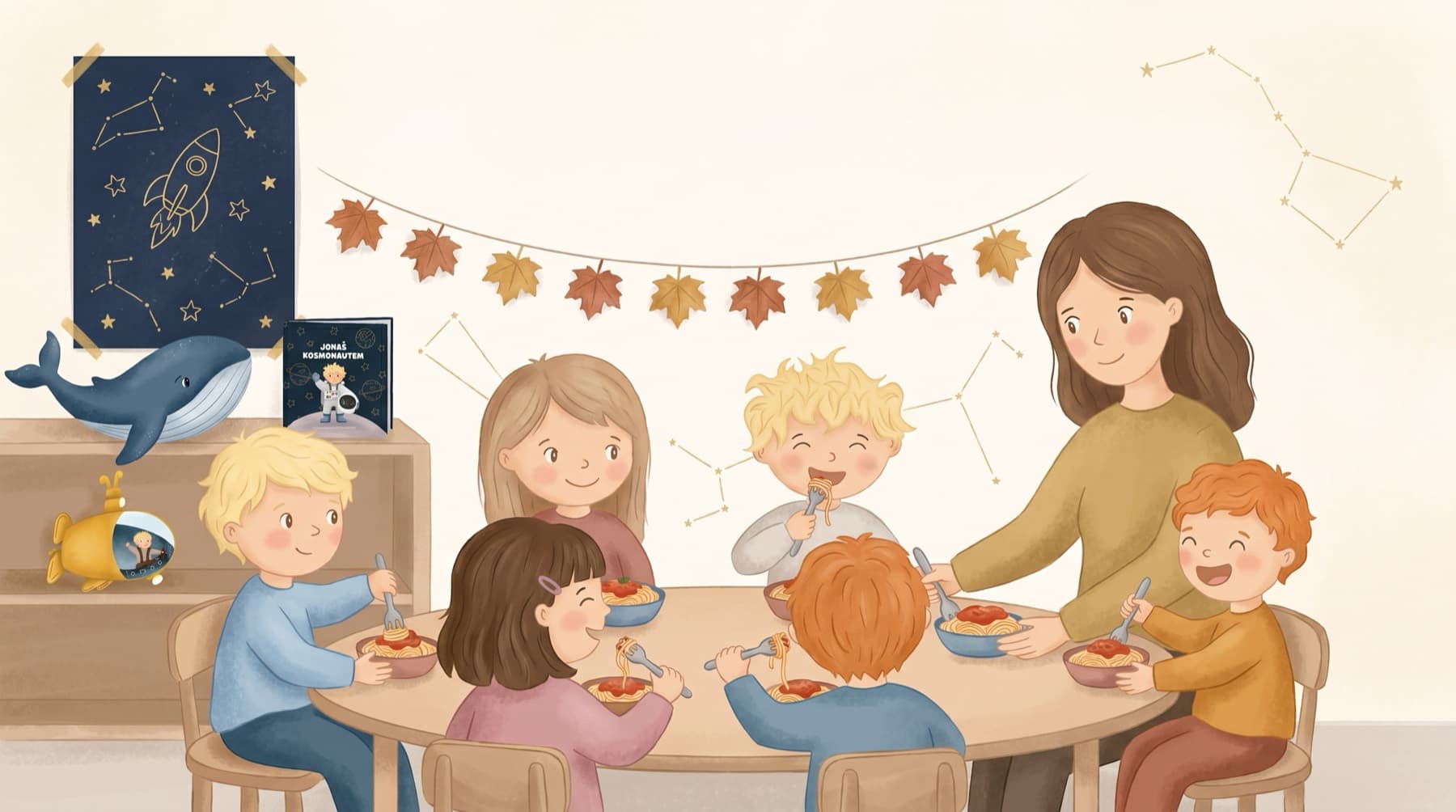
Fruit and vegetables offered with every meal
Children here have fruit and vegetables within reach at every meal – not as a compulsory side dish at lunch, but as a natural part of the table at every snack time. Lunches are served, but snacks are something we prepare together with the children – and beyond the snack itself, fruit and vegetables are always there for the taking. We don’t push them as a task; they’re simply on the table, alongside everything else, and children choose for themselves what to take. Some days a child takes a lot, other days almost nothing – and both are fine, because what matters is that the choice is there and the child makes it for themselves.
We decide what’s served, your child decides how much to eat
We follow a simple rule known as the Division of Responsibility, developed by the American dietitian Ellyn Satter – and it works beautifully for us: we, the adults, decide what is served, when, and at which table; the child decides whether to eat any of it and how much. This boundary gives us peace of mind, because we know exactly where our responsibility ends and where the part only the child can live through begins. And it gives the child trust – the certainty that we take their hunger and their fullness seriously, even while they’re still very small.
Why we never force children to eat
We don’t make children clean their plates – and it’s not because we don’t take food seriously, but precisely because we do. A child under pressure is a child under stress, and stress takes appetite away rather than adding to it – so a child who is forced to eat paradoxically eats less, not more. And food they had to eat when they didn’t want to is easily remembered as something unpleasant. What we care about most is that children never stop trusting their own sense of fullness – small children still have it beautifully tuned, and it would be a shame to break it.
In the short term, “one more bite and you’re done” may work – but in the long run it loses, because you can win a single lunch, while a relationship with food is built over years. So instead of pressure, we simply offer the food and leave it on the table without coaxing. Children often come to like a new food only after the tenth or fifteenth encounter, and it works best at a table with other children – because eating is something children learn most of all from each other.
Why there’s no such thing as healthy and unhealthy food here
We don’t divide food into good and bad, because the moment we do, a child sooner or later applies that division to themselves – and from “I ate something forbidden” it’s only a small step to “I’m naughty, I’m bad.” Besides, whatever is forbidden always tastes best, so children who one day get to it unsupervised eat far more of it, long after their hunger is gone. No single snack or lunch will save anyone, and none will ruin anyone either – whether a diet is balanced is decided by the whole week, not by one meal. And balance doesn’t mean perfection; it just means enough varied food on the plate, often enough. We also never use food as a reward or a punishment – that would turn food into a currency, and that is exactly the way to develop a strange relationship with it.
How we handle sweets
Sweets aren’t a normal part of the day in our group – children simply don’t see them here. But that doesn’t mean we ban sugar. In summer we go out for ice cream, at Christmas we bake gingerbread together, and when someone in the group has a birthday, they share a piece of cake with everyone – and all of that is on purpose. It’s not about prohibition, it’s about rhythm: sweets have their place in childhood, we just believe that place is a special occasion and a shared table – not a pocket, as a secret reward. That’s how a child learns that cake is food, not treasure to be snatched when nobody’s looking.
Who cooks our lunches
Our lunches are delivered by Jihočeská kuchyně, a South Bohemian company that cooks from fresh ingredients with no processed shortcuts – they peel their own potatoes, knead their dumplings by hand, and source their meat and poultry from their own farms and local suppliers. So you know exactly where the food your child eats comes from. Snacks and the all-day offer of fruit and vegetables, on the other hand, are our own doing – what your child eats between lunches is taken care of by us, right here in our group.
Allergies, special diets and food that follows your convictions
Whether your child needs a gluten-free or dairy-free diet, has an allergy, or your family eats vegetarian at home and you’d like it to stay that way with us – just tell us and we’ll arrange it. We can accommodate virtually any dietary requirement; the main thing is to let us know in advance, so your child has exactly what they need on their plate from day one.
You decide how your child should eat
Whatever your views on food, if there’s something specific you don’t want your child to be given, tell us and we will respect it – without explaining, without debating, because you are the one who decides for your child, not us. Our own convictions about how one should eat never override your decision, and that holds even when each of us thinks something slightly different about food.
Have a question about meals?
Parents tend to have more questions about food than one web page can hold, and they’re best answered in person. But you’re also welcome to call or write to us, if that’s easier for you.
What if my child eats almost nothing at lunch?+
It happens, and it’s no cause for worry – children’s appetites change from day to day, just like adults’. And don’t worry about your child going hungry: you tell us what they like, and we always have something else to offer them.
Do children get sweets at your preschool?+
Not as part of an ordinary day – so children don’t associate sweets with the everyday. But on special occasions, yes: in summer we go out for ice cream, at Christmas we bake gingerbread together, and at a birthday party every child shares a piece of cake with the others.
Can you handle a special diet or an allergy?+
Yes – we can accommodate virtually any diet, whether it’s gluten-free or dairy-free food, an allergy, a vegetarian diet, or eating according to your convictions. Just tell us in advance, so your child has exactly what they need from their very first day – and never has to sit apart because of food.
What if we don’t want our child to eat something specific, even without a medical reason?+
We’ll respect it, no questions asked. Tell us what you wish for your child and we’ll follow it – because how your child eats is your decision, not ours.
Want to be there when we open?
Leave us your contact info and you'll be among the first to hear when enrollment opens.
Leave us your details